
As an Australian business owner, you wear countless hats. But what happens when growth stalls, or you’re facing a strategic crossroad you can’t navigate alone? It’s a common feeling-being so deep in the daily operations that you lack the time or perspective to plan for the future. You don’t have to have all the answers. This is precisely where professional business advisory services provide the strategic clarity and financial expertise needed to break through and regain momentum.
This ultimate guide is designed to put you back in the driver’s seat. We’ll demystify what business advisory truly entails, help you identify the critical moments when you need it most, and show you how to select the right partner for your unique journey. Our goal is simple: to give you the confidence and a clear roadmap to solve persistent problems, improve your cash flow, and take firm control of your business’s future.
Key Takeaways
- Understand how a business advisor moves beyond consulting to provide specialised expertise, helping you solve complex problems and unlock new growth opportunities.
- Identify the critical stages in your business lifecycle-from cash flow pressures to scaling operations-that signal it’s time to seek external advice.
- Follow a clear framework to confidently select the right business advisory services for your SME, ensuring you partner with an expert who truly understands your goals.
- Discover the tangible, bottom-line results you can expect, starting with robust financial compliance as the bedrock of any sustainable growth strategy.
Beyond the Buzzword: What Do Business Advisors *Actually* Do?
The term business advisory services can often feel like a vague corporate buzzword. In reality, the concept is straightforward: it’s about engaging external expertise to solve specific problems, overcome challenges, and unlock your company’s true growth potential. At its core, understanding what is a business advisor means seeing them not as a single, all-knowing guru, but as a network of specialists you can call upon when you need them most.
Think of it like your relationship with a doctor. Your GP is your first point of call for general health, but if you have a specific heart issue, they refer you to a cardiologist. A business advisor works the same way. They help diagnose the overall health of your business and then act as the right specialist to treat a specific challenge, whether it’s with your long-term strategy, your finances, or your day-to-day operations.
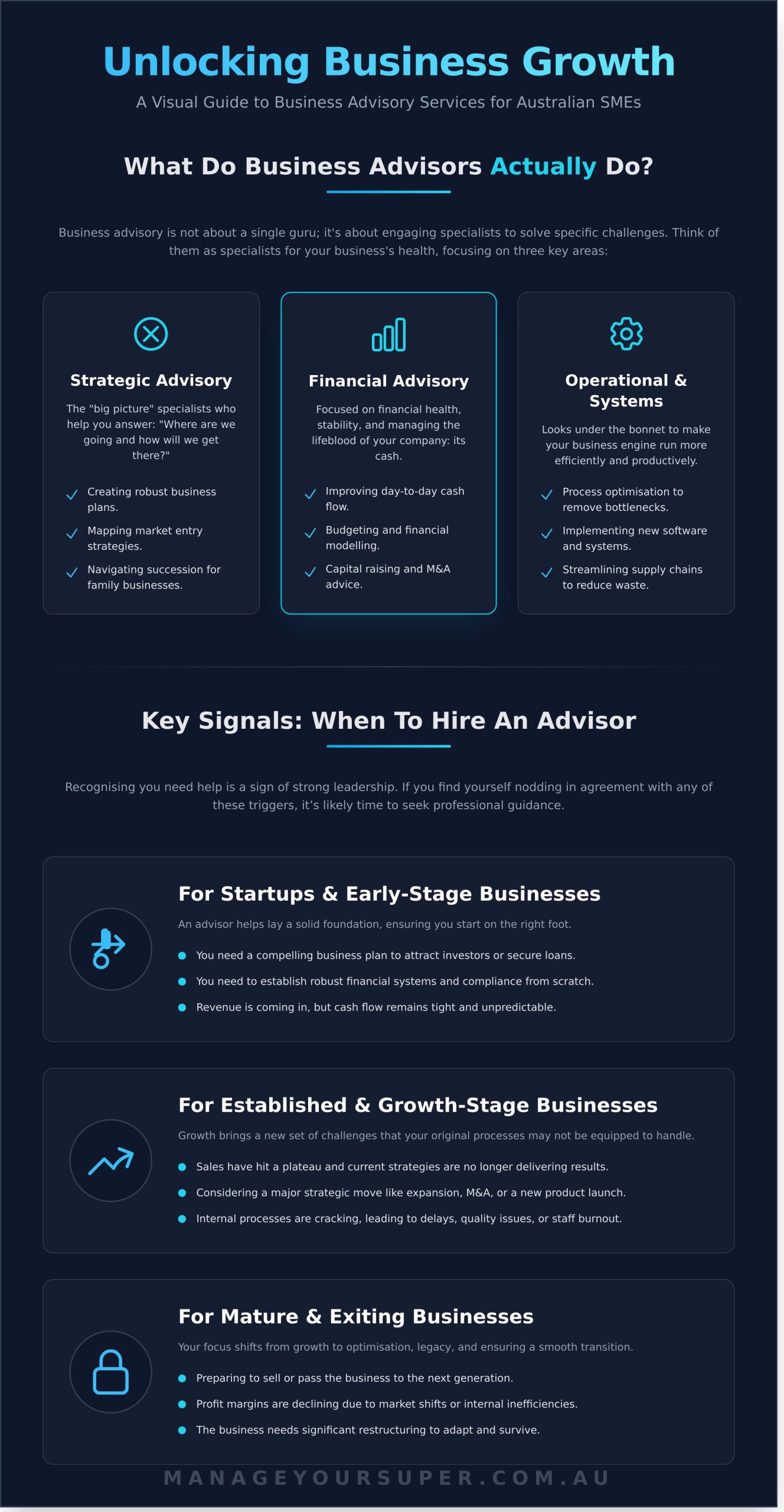
This approach ensures you get targeted, effective advice precisely where you need it. The main categories of advisory generally fall into three key areas:
Strategic Advisory
This is the “big picture” specialist. They help you answer the critical questions: “Where are we going and how will we get there?” This includes creating robust business plans, navigating a smooth succession for family businesses, or mapping out a market entry strategy. It’s ideal when your business is at a crossroads, facing new competition, or preparing for significant expansion.
Financial Advisory
Focused squarely on the financial health and stability of your business, this advisor helps you manage the lifeblood of your company: its cash. Services range from improving day-to-day cash flow management and budgeting to complex financial modelling for capital raising or merger and acquisition (M&A) advice. Engaging a financial advisor is crucial for improving profitability and ensuring long-term financial resilience.
Operational & Systems Advisory
This specialist looks under the bonnet to make your business engine run more efficiently. If you’re struggling with scaling, find that internal processes are creating bottlenecks, or feel your technology is holding you back, they can help. Their work involves process optimisation, implementing new software and systems, and streamlining supply chains to boost productivity and reduce waste.
Key Signals: When Should You Hire a Business Advisor?
Recognising you need external expertise isn’t a sign of weakness; it’s a hallmark of strong leadership. The most successful business owners know they can’t be experts in everything. They build a team of trusted advisors to gain an objective perspective and navigate complex challenges. Think of the following points as a diagnostic tool. If you find yourself nodding in agreement with any of them, it’s likely time to seek professional guidance.
Triggers for Startups & Early-Stage Businesses
In the beginning, every decision shapes your future. An advisor helps lay a solid foundation, ensuring you start on the right foot. Key triggers include:
- Funding and Planning: You’re struggling to create a compelling business plan that attracts investors or secures that crucial initial loan.
- Systems Setup: You need to establish robust financial systems, reporting structures, and compliance frameworks from scratch but aren’t sure where to begin.
- Cash Flow Puzzles: Revenue is coming in, but cash flow remains tight and unpredictable, putting the business at risk.
Triggers for Established & Growth-Stage Businesses
Growth brings a new set of challenges that your original processes may not be equipped to handle. This is often where specialised business advisory services provide the most significant impact. Watch for these signals:
- Stagnant Growth: Sales have hit a plateau, and your current strategies are no longer delivering the results they used to.
- Major Strategic Moves: You are considering a significant expansion, a merger or acquisition, or launching a new product line and need a clear-eyed risk assessment.
- Operational Strain: Your internal processes are cracking under pressure, leading to service delays, quality issues, or staff burnout.
Triggers for Mature & Exiting Businesses
As your business matures, your focus shifts from growth to optimisation and legacy. An advisor is critical for maximising value and ensuring a smooth transition. Consider seeking help when:
- Succession and Sale: You’re preparing to sell the business or pass it to the next generation and need to structure the entity for maximum value and minimal friction.
- Declining Profitability: Market shifts or internal inefficiencies are eroding your profit margins, and a fresh perspective is needed to turn things around.
- Complex Restructuring: The business needs to undergo a significant restructure or turnaround to remain viable and competitive for the future.
Identifying these triggers is the crucial first step. Once you know you need support, the next is finding the right partner. A great advisor brings clarity and confidence, and learning how to choose a business advisor is a vital skill that will pay dividends for years to come.
Choosing Your Advisor: A 5-Step Framework for the Right Fit
Engaging a business advisor is a significant investment in your company’s future. The fear of choosing the wrong, expensive partner is a valid concern, but it doesn’t have to be a roadblock. This simple five-step framework is designed to remove the guesswork, giving you the confidence to find a partner who will deliver real value.
Step 1: Clearly Define Your Problem. Before you start looking, you must know what you need to fix or achieve. Are you struggling with cash flow management, planning a business succession, or trying to secure capital for expansion? Write down your single biggest challenge. A clear problem statement is the foundation for finding the right solution.
Step 2: Research Advisors with Proven Experience. Look for advisors who have a track record in your specific industry and with your specific problem. Generalists can be helpful, but a specialist who understands the nuances of your sector can provide far more targeted and effective strategies. The right firm will have demonstrable experience in the exact kind of business advisory services you require.
Step 3: Check Credentials and Case Studies. Due diligence is non-negotiable. Verify their qualifications, look for testimonials, and ask for case studies from businesses similar to yours. A reputable advisor will be transparent and proud to share their past successes.
Step 4: Understand Their Engagement and Fee Structure. There should be no surprises when it comes to cost. Ask if they charge on an hourly rate, a fixed project fee, or a monthly retainer. Ensure you understand what is included in the fee and what might be an additional expense. This clarity protects you and sets clear expectations from the start.
Step 5: Conduct a Chemistry Check. This is the final, crucial piece of the puzzle. You will be working closely with this person, sharing sensitive information about your business. You need to feel comfortable that you can have open, honest conversations. Trust your intuition-if the connection doesn’t feel right, it probably isn’t.
Where to Look for Reputable Advisors
Finding a qualified advisor starts with looking in the right places. These resources are an excellent starting point for your search in Australia:
- Industry Associations: Bodies like Chartered Accountants Australia and New Zealand (CA ANZ) or CPA Australia have directories of accredited professionals.
- Your Professional Network: Ask for referrals from trusted contacts such as your lawyer, accountant, or banking manager.
- Government Programs: Explore directories and programs supported by government bodies like business.gov.au.
Key Questions to Ask a Potential Advisor
During your initial conversations, be prepared with questions that get to the heart of their value. This helps you move beyond the sales pitch and understand how they truly operate:
- ‘Can you share a case study of a business like mine that you’ve helped, and what were the outcomes?’
- ‘How do you measure the success and return on investment (ROI) of your advisory work?’
- ‘What will be expected of me and my team during this engagement to ensure we get the best results?’
- ‘What are the exact deliverables I will receive at the end of our project or on a recurring basis?’
Measuring the ROI: What Tangible Outcomes Can You Expect?
A common objection is that advisory is just “talk.” But effective business advisory services are built on a foundation of action and accountability. The goal isn’t just to provide suggestions; it’s to help you implement strategies that deliver a clear, positive return on your investment. This is about moving from simply working in your business to working on it, with a clear focus on measurable growth that you can see and feel.
Financial & Quantitative Wins
The most direct way to measure success is by looking at your bottom line. A skilled advisor helps you identify and act on opportunities that have an immediate and lasting financial impact. You can expect to see tangible results in key areas:
- Increased Gross Profit Margin: Through a detailed review of your pricing strategy, supplier costs, and operational efficiencies, you can directly boost the profitability of every single sale.
- Improved Cash Flow Cycle: We help you implement systems to reduce debtor days, manage inventory better, and shorten the time it takes to turn your hard work into cash in the bank.
- Successful Capital Raising: By preparing professional financial models and a compelling business case, you are positioned to secure favourable loan terms from Australian banks or attract external investment.
- Higher Business Valuation: A structured approach to growth and systemisation makes your business a more valuable asset, preparing you for a future high-value sale.
Strategic & Qualitative Wins
While not always captured on a profit and loss statement, strategic gains are crucial for long-term stability and your personal well-being. These outcomes build a stronger, more resilient, and more enjoyable business to run.
- A Clear, Documented Strategic Plan: Move from reactive decision-making to proactive growth with a roadmap that aligns your entire team towards common, achievable goals.
- Reduced Owner Stress and Workload: By developing better systems and delegation strategies, you can reclaim your time and reduce the day-to-day pressure of running the business.
- A Smooth Succession or Exit: Planning your exit well in advance ensures a seamless transition and maximises the financial return for your life’s work.
- Improved Team Morale and Efficiency: Clear roles, effective processes, and a shared vision lead to a more engaged, productive, and stable team.
Ultimately, engaging an advisor is about creating tangible value that far outweighs the cost. It’s a strategic investment in taking control of your business’s future, ensuring it not only survives but thrives.
Financial Compliance: The Advisory Service You Can’t Ignore
While many business advisory services focus on growth, marketing, and operations, the bedrock of any sustainable strategy is robust financial governance. This isn’t just about good practice; it’s about the law. Certain advisory functions, like audits and financial reporting, are non-negotiable requirements mandated by regulatory bodies like the Australian Taxation Office (ATO). Getting this right isn’t a box-ticking exercise-it’s fundamental to protecting your business and its future.
Why Compliance is a Critical Advisory Function
Effective compliance management is more than just avoiding fines. It’s a strategic asset that builds a resilient and trustworthy business. When your financial house is in order, you:
- Protect the business and its directors from significant ATO penalties and legal risks.
- Build trust with key stakeholders, including investors, lenders, and potential buyers who demand financial transparency.
- Ensure the accuracy of the data you rely on for every critical strategic decision, from budgeting to expansion.
The Role of SMSF Audits for Business Owners
For many Australian business owners, a Self-Managed Super Fund (SMSF) is a powerful tool for building wealth. But with this control comes strict legal duties. The ATO mandates an annual independent audit for every SMSF, making it one of the most critical compliance services a director will engage. This isn’t just paperwork; it’s a specialised process designed to ensure your fund is compliant and your retirement savings are protected.
This independent review verifies your fund’s financial statements and confirms it has complied with superannuation laws. It provides the peace of mind that your nest egg is secure and managed correctly. While we focus on making SMSF compliance simple and stress-free, we believe that taking control of your finances is the first step to both personal and business success.
Partnering for Progress: Your Next Step to Sustainable Growth
Navigating the complexities of running an SME in Australia requires more than just hard work-it demands strategic foresight. As we’ve explored, engaging the right business advisory services is not a cost, but a powerful investment in your company’s future. It’s a proactive step towards sustainable growth. From identifying the crucial signals that it’s time to seek help, to choosing the right partner and ensuring rock-solid financial compliance, the right advisory relationship can unlock potential and transform your entire business trajectory.
While a general advisor provides a broad overview, mastering critical areas like financial compliance requires a specialist’s touch. As specialist independent auditors trusted by accountants and trustees across Australia, we provide the clarity you need with a transparent, fixed-fee structure, ensuring there are no surprises. Learn how to take control of your financial future with expert guidance.
Your business’s future is in your hands-let’s build it with confidence.
Frequently Asked Questions
How much do business advisory services cost in Australia?
The cost of business advisory services in Australia varies based on the scope of work and the advisor’s experience. You might encounter hourly rates from A$200 to A$500+, or project-based fees for specific outcomes like a business plan, which could be several thousand dollars. Many businesses opt for a monthly retainer, typically ranging from A$1,000 to A$5,000+, for ongoing strategic guidance and support. It’s about finding the value that drives your business forward.
What is the difference between a business coach and a business advisor?
A business coach focuses on you, the owner, helping you develop leadership skills, mindset, and accountability. They ask powerful questions to help you find your own solutions. A business advisor, on the other hand, focuses on the business itself. They provide direct, expert advice on strategy, finance, and operations, drawing on their own experience to give you concrete answers and a clear path forward. An advisor gives you the “how,” while a coach helps you with the “why.”
Do I need a business advisor if I already have an accountant?
While there can be overlap, their core functions are different. Your accountant is typically focused on historical data-ensuring tax compliance, managing bookkeeping, and reporting on past performance. A business advisor is forward-looking. They use that financial data to help you strategise for growth, improve profitability, and navigate future challenges. An advisor helps you build the future of your business, not just record its past.
How long is a typical business advisory engagement?
The length of an engagement is tailored to your specific needs. It could be a short-term project lasting a few months to tackle a specific challenge, like preparing for a capital raise or improving cash flow. More commonly, it’s a long-term partnership of 12 months or more, with regular meetings to provide ongoing strategic direction, accountability, and a sounding board for your ideas. The goal is to build a lasting relationship that supports your growth journey.
Can a business advisor help me get a business loan?
Yes, a business advisor can be a crucial asset when seeking finance. They help you prepare a professional business plan and robust financial forecasts that lenders require. Their expertise ensures your application is comprehensive and compelling, which significantly increases your chances of approval. Quality business advisory services add a layer of credibility, showing lenders you have a solid strategy and expert guidance to ensure the business succeeds.
Are business advisory fees tax-deductible in Australia?
Yes, in Australia, expenses incurred for professional advice to help run and grow your business are generally tax-deductible. This means the fees you pay for a business advisor can typically be claimed as a legitimate business operating expense. We always recommend you confirm the specifics with your accountant or registered tax agent to ensure it aligns with your unique financial situation and the latest ATO guidelines.
What qualifications should a good business advisor have?
A great business advisor blends formal qualifications with real-world experience. Look for credentials like a degree in business or finance, or a CA/CPA designation. More importantly, seek an advisor with a proven track record of growing businesses, ideally in your industry. They should possess strong analytical skills to interpret your data and excellent communication skills to translate it into a clear, actionable strategy you can implement with confidence.